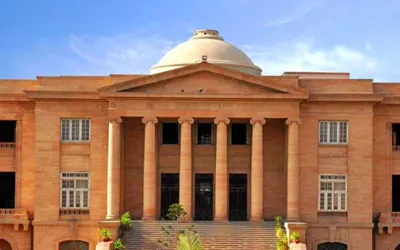
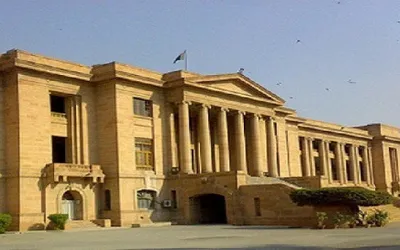
KARACHI: The Sindh High Court on Wednesday struck down a decades-old restriction on Christian divorce, allowing couples in the province to seek dissolution of marriage on grounds beyond adultery.
A two-member constitutional bench headed by Justice Yousuf Ali Sayeed ruled that the removal of Section 7 of the Divorce Act of 1869 was inconsistent with Articles 9, 14, 20 and 25(2) of the Constitution and was void under Article 8(1) to the extent of that inconsistency.
The provision was omitted in July 1981 through an ordinance issued during the military rule of Gen. Ziaul Haq. Its removal severely restricted the grounds on which Christian spouses could seek divorce, leaving adultery as the principal basis for ending a marriage.
The ruling came in response to a petition filed in 2023 by an NGO providing free legal assistance to marginalized communities, including religious minorities, and two Christian citizens. They asked the court to declare the omission unconstitutional and direct district and family courts in Sindh to disregard it.
The petitioners argued that the restriction forced Christians to remain in marriages that had irretrievably broken down unless they could prove adultery. They said the law violated fundamental rights, including personal liberty and dignity, and discriminated against Christians compared with followers of other religions, as well as against Christian women.
They also maintained that conversion to another faith or accusations of adultery had become among the few practical ways for spouses to end their marriages.
Federal and provincial law officers did not directly counter the petitioners' arguments about the impact of the omission. Instead, they maintained that the ordinance was protected under Article 270A of the Constitution and said new legislation on the matter was under consideration at both federal and provincial levels.
The Archbishop of Karachi opposed the petition, arguing that the petitioners lacked legal standing to represent the Christian community. He also said any reform should follow meaningful consultation with Christian denominations and representative organizations.
His counsel further argued that the Roman Catholic Church regards marriage as a sacred sacrament governed by Canon Law, warning that reforms affecting its religious doctrine or ecclesiastical authority could violate Article 20, which guarantees freedom of religion.
In its judgment, the SHC observed that the existing law recognized cruelty and desertion lasting two years or more as grounds for judicial separation, but did not allow either to independently justify divorce.
The bench noted that judicial separation allowed spouses to live apart without ending their marriage, leaving neither free to remarry.
It also highlighted the unequal grounds available to men and women. A husband could seek divorce on proof of adultery, while a wife had to establish adultery alongside an additional circumstance or rely on other specified grounds, including conversion followed by another marriage, rape, sodomy or bestiality.
The court referred to a 2017 Lahore High Court ruling that restored Section 7 in Punjab, describing it as a carefully reasoned decision that examined the law against constitutional guarantees of dignity, equality and religious freedom.
The SHC also noted that the 18th Amendment transferred legislative authority over marriage and divorce to the provinces. Under Article 270AA(6), existing laws continued to remain in force until amended, repealed or altered by the competent authority.
Since the Sindh Assembly had not amended the relevant law, the bench said it was the provincial legislature's responsibility to do so.
The judges stressed that spouses who had lived apart for years and mutually wanted to end their marriages had no lawful way to do so without one accusing the other of adultery. They described the restriction as a serious interference with personal liberty.
The bench ultimately agreed with the Lahore High Court's reasoning and ruled that the omission of Section 7 violated constitutional protections under Articles 9, 14, 20 and 25(2).