A stretch of yellow-painted concrete blocks running through parts of the Gaza Strip has become a powerful symbol of a new reality for Palestinians: a de facto internal border that dictates where people can live, move and survive.
Known locally as the “yellow line,” the boundary marks the furthest point of Israeli military redeployment under the first phase of the ceasefire that came into effect in October. According to Israeli military maps, the line extends between 1.5 and 6.5 kilometers inside Gaza from its eastern border with Israel, placing roughly 58 percent of the enclave under direct Israeli military control.
On the Palestinian side of the line, daily life unfolds under constant uncertainty. Just meters from the yellow blocks in eastern Gaza City, Zaid Mohammed, a displaced father of four, shelters with his family in a small tent pitched amid the ruins of destroyed homes.
“Israeli soldiers are only a few hundred meters from here,” Zaid said, gesturing toward the eastern horizon where the sound of gunfire and drones is a near-constant presence. “It’s dangerous to move even a few steps. Sometimes we hear bulldozers demolishing what’s left of houses or farmland.”
Two zones
The yellow line divides Gaza into two zones: an eastern area under Israeli military control and a western area where Palestinians face fewer movement restrictions but remain vulnerable to air strikes, displacement orders and sudden shifts in what is deemed “safe.”
Although not formally recognized as an international boundary, the line functions as a powerful internal border. United Nations agencies and humanitarian organizations say it has expanded, shifted and retracted repeatedly during the war, creating fluid but deadly constraints on civilian movement.
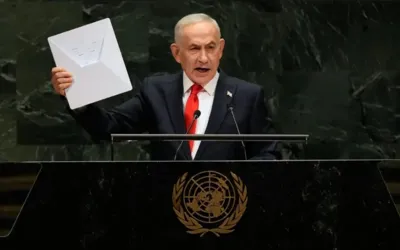
During a visit to Gaza in December, Israeli Chief of Staff Lieutenant General Eyal Zamir described the yellow line as “a new border line,” signaling Israel’s intent to retain long-term control over large swathes of the territory. The areas affected include key regions such as Rafah in the south and Beit Hanoon in the north.
The line’s emergence is the result of a series of forced displacement orders issued by the Israeli military throughout the conflict. These orders were often delivered through leaflets, phone messages or online maps, sometimes while bombardment was ongoing, giving civilians little time or clarity to evacuate safely.
The UN Office for the Coordination of Humanitarian Affairs (OCHA) has reported that at various points more than 70 percent of Gaza’s territory was either under evacuation orders or classified as unsafe.
Invisible line
On the ground, however, the yellow line is often invisible. In many areas, there are no signs or clear markings. Residents rely instead on sound, memory and instinct to determine where danger begins.
“A street that felt safe yesterday can be deadly today,” said one aid worker in central Gaza, speaking on condition of anonymity. “People pack up and flee even if their homes are still standing, because the rules change overnight.”
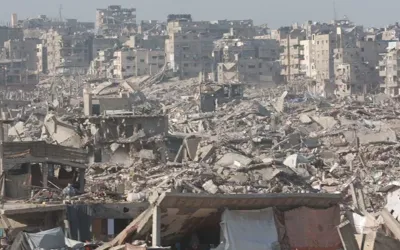
The cumulative toll has been immense. Israel’s war on Gaza has destroyed or damaged more than 80 percent of buildings in the enclave, home to around 2.3 million people. A UN official said last week that clearing more than 60 million tons of rubble could take over seven years.
Most of Gaza’s population has been displaced at least once, with many forced to move multiple times. Families now live in tents or bombed-out buildings, often close to military zones.
Living under these conditions has had severe psychological consequences. Mental health professionals working with the World Health Organization and UNICEF report widespread anxiety, insomnia and trauma, particularly among children.
“Children have learned new maps of safety,” said a Gaza-based psychologist working with an international NGO. “They know which streets are forbidden, how to react to drones, when to run. That kind of normalization of danger leaves deep scars.”