Saudi Crown Prince Mohammed bin Salman’s return to Washington, the first since 2018, signals a reinvigoration of U.S.-Saudi ties amid a renewed regional strategic landscape. Central to this diplomatic rapprochement is the potential U.S. sale of the advanced F-35 stealth fighter jet a move that could significantly alter the Middle East’s military balance.
The F-35: The Pinnacle of Modern Warfare:
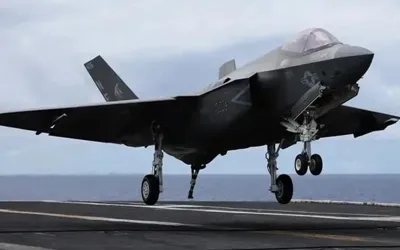
Developed by Lockheed Martin, the F-35 Lightning II stands as arguably the world’s most sophisticated fighter jet. Its cutting-edge stealth technology, integrated sensors, and high-speed computing enable it to evade enemy detection, strike with precision, and share battlefield intelligence across allied forces.
Unlike traditional fighters that rely solely on speed and agility, the F-35’s core advantage lies in “seeing first, shooting first,” transforming modern air combat.
Family of Variants:
The F-35 platform is not one-size-fits-all but a family of variants tailored to diverse needs:
F-35A: The standard version for the U.S. Air Force. F-35I: “Adir”: Israel’s customized variant, featuring advanced electronic warfare capabilities. F-35B: Short takeoff and vertical landing, ideal for limited spaces and smaller ships. F-35C: Designed for carriers, with long-range and stealth capabilities suited for the U.S. Navy.
Why F-35 Matters:
The aircraft symbolizes a leap in aerial warfare technology, integrating sensors and data-sharing systems to create a networked force that can coordinate across domains—air, land, and sea. For nations like Saudi Arabia, which operate older-generation fighters, acquiring the F-35 would mark a significant upgrade in military capability and regional influence.
Which countries have f-35 fighter jets?

Saudi Ambitions and Strategic Motivations:
Although a major U.S. weapons buyer, Saudi Arabia has long been excluded from the F-35 program until now. The desire to modernize its air force, project regional strength, and bolster deterrence against Iran drives Riyadh’s pursuit.
The F-35’s potential sale would not only enhance Saudi capabilities but also elevate its status among Middle Eastern powers, alongside Israel and the UAE.
U.S. Perspectives and Regional Dynamics:
Historically, U.S. hesitation over the sale stemmed from concerns over Israel’s qualitative military edge. However, shifting regional geopolitics including warming Arab-Israeli relations and shared apprehensions over Iran have prompted a reassessment.
The current U.S. administration views the potential deal as an opportunity to reinforce alliances and foster a coalition aligned with American interests.
The possible sale of F-35 jets to Saudi Arabia marks more than a military upgrade; it reflects evolving regional alliances and strategic priorities. As the U.S. navigates these complex dynamics, the F-35 remains at the forefront of modern warfare and Middle Eastern geopolitics.