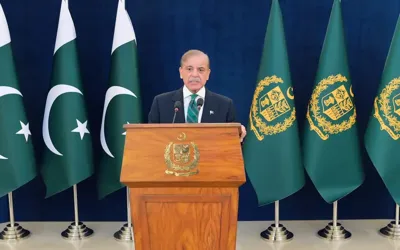
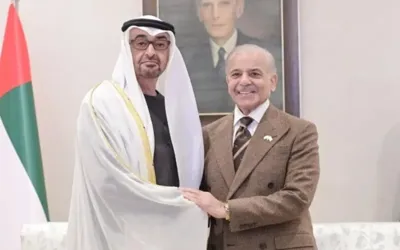
Prime Minister Shehbaz Sharif told the United Nations General Assembly on Friday that any attempt by India to stop, block or divert Pakistan’s share of water would be considered an “act of war.”
“Water must never be weaponised. Rivers should nourish nations, not divide them. Therefore, any attempt to stop, impede or divert Pakistan’s share of the waters will be treated as an act of war. India must make no mistake about it,” he said.
The prime minister was addressing the 81st session of the United Nations General Assembly in New York.
“The pursuit of peace is among the noblest of human endeavours,” Shehbaz said at the beginning of his speech. He said Quaid-i-Azam Muhammad Ali Jinnah’s support for the U.N. Charter had shaped Pakistan’s national values and guided its policies at home and abroad.
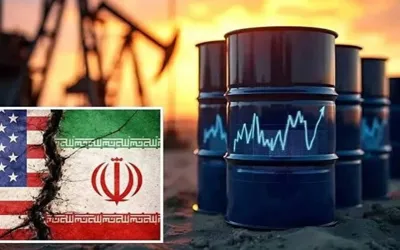
The prime minister also spoke about the conflict in the Gulf and the wider Middle East, highlighting the loss of lives, economic difficulties and pressure on important maritime routes, particularly the Strait of Hormuz.
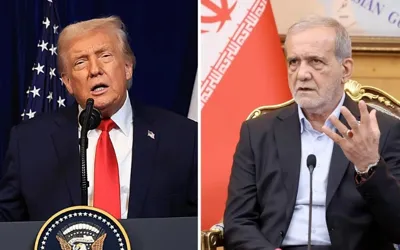
“At this critical moment, Pakistan chose to act swiftly. Through concerted efforts, Pakistan brought Washington and Tehran under one roof in Islamabad,” Shehbaz said, referring to the Islamabad Talks that led to the signing of the Islamabad Memorandum of Understanding between the United States and Iran in June.
He praised Chief of Defence Forces and Chief of Army Staff Field Marshal Asim Munir for his “relentless efforts” to create room for diplomacy during difficult circumstances. He also praised Deputy Prime Minister and Foreign Minister Ishaq Dar for his role in the process.
“Amid the roar of missiles, drones and guns, the voice for diplomacy must echo even louder and stronger,” the prime minister said.
He said the Strait of Hormuz and Bab al-Mandab were important routes for the global economy and should remain open for international trade instead of becoming points of confrontation.
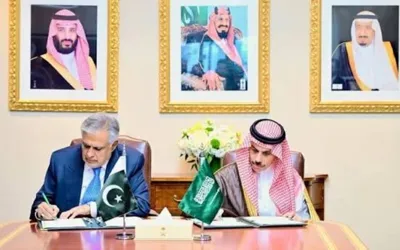
Shehbaz also strongly condemned recent Houthi attacks against Saudi Arabia, describing them as “deplorable” and expressing Pakistan’s full solidarity with the kingdom.
He also mentioned the Makkah Joint Defence Agreement signed by Pakistan, Turkiye and Saudi Arabia, saying it reflected Pakistan’s commitment to peace.
“This alliance is not directed against any country; it is a collective commitment for defence, stability and peace in the region, and nothing more,” he said.
The prime minister also spoke about last year’s conflict with India, which followed a terrorist attack in Pahalgam that New Delhi blamed on Islamabad. Pakistan denied the allegations.
“Our brave and valiant armed forces, under the courageous leadership of Field Marshal Asim Munir, responded with precision and professionalism,” he said.
Shehbaz again praised U.S. President Donald Trump for what he called “resolute and visionary leadership” in helping broker a ceasefire between Pakistan and India in May 2025. He said the ceasefire saved “hundreds of millions of lives.”
“Who knows the extent of devastation that could have taken place had President Trump not stepped in at this critical moment with clarity of thought and action?” he said.
“We must therefore ensure that South Asia never reaches this precipice ever again.”
Shehbaz said achieving this would require a fair resolution of the Kashmir dispute.
“For eight decades, the Kashmiri people have waited for the United Nations to fulfill its solemn commitment of a free and impartial plebiscite,” he said, adding that they had faced “illegal occupation, arbitrary detention, extrajudicial killings, enforced disappearances, sexual violence and collective punishment” for generations.
He said Pakistan would continue to provide full diplomatic, political and moral support to Kashmiris until they achieved their right to self-determination, describing Kashmir as “Pakistan’s jugular vein.”