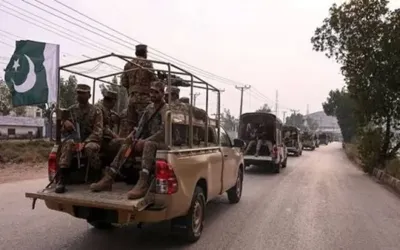
ISLAMABAD: Prime Minister Shehbaz Sharif has defended the government's decision to introduce emergency measures in Khyber Pakhtunkhwa, claiming that militants were brought back from Afghanistan and resettled in the province in 2019 and 2020, contributing to renewed security threats.
Addressing Pakistan Muslim League-Nawaz (PML-N) lawmakers and party officials in Islamabad, he said the measures were necessary to protect residents, national security and the country's economic and social stability. During his speech, Shehbaz Sharif described Khyber Pakhtunkhwa as a vital part of Pakistan and praised its residents for their courage, resilience and sacrifices in the fight against terrorism.
He also highlighted the PML-N's role in supporting democratic traditions in the province. Referring to the 2013 general elections, the prime minister said former Prime Minister Nawaz Sharif had respected the election results and allowed the party with the most seats to form the provincial government. However, Shehbaz Sharif questioned the performance of the political party that had governed Khyber Pakhtunkhwa for the past 13 years.
He asked how many new universities and hospitals had been built during that period, arguing that political divisions and slogans had received more attention than public welfare. He said residents across Peshawar, Kohistan, Hazara and the province's southern districts continued to face serious problems that required attention from the provincial government.
Discussing the fight against terrorism, the prime minister acknowledged the enormous sacrifices made by local communities, police officers, security forces and political leaders. He recalled the Army Public School attack in Peshawar, describing the deaths of innocent children as one of the darkest tragedies in Pakistan's history.
Shehbaz Sharif said Pakistan had previously made significant progress against terrorism through united national efforts under Nawaz Sharif's leadership. However, he stated that militants returning from Afghanistan and settling in Khyber Pakhtunkhwa during 2019 and 2020 contributed to the renewed wave of violence.
He added that the federal government had repeatedly called for cooperation to address the growing security threat, but its proposals had not received the response it expected. The prime minister also raised questions about how the provincial government had spent financial resources received through the National Finance Commission (NFC) Award.
He said Khyber Pakhtunkhwa had secured an additional 1% share under the 2010 NFC arrangement and had received approximately Rs800 billion through the allocation. Shehbaz Sharif questioned how many Safe City projects had been completed with the available funding and whether the provincial Counter Terrorism Department (CTD) had received enough support to tackle security challenges.
He also highlighted the reported shortage of police personnel, saying approximately 5,000 positions remained vacant. He argued that provincial resources should have been used to recruit more officers, provide modern weapons and improve police training. Turning to national politics, the prime minister said repeated demonstrations and political sit-ins over the previous two and a half years had affected Pakistan's political environment and economic progress.
He recalled that protests in 2014 had delayed Chinese President Xi Jinping's planned visit to Pakistan. The Chinese leader eventually visited in 2015, when the two countries signed important agreements. Shehbaz Sharif also credited Nawaz Sharif's government with addressing the country's prolonged electricity shortages, which he said had previously resulted in power outages lasting as long as 20 hours a day.
Speaking about the economy, the prime minister said Pakistan's political and military leadership had worked together to improve economic stability. He acknowledged that international developments and the conflict in the Gulf had caused an extraordinary increase in energy prices, creating additional financial pressure on ordinary citizens. To ease the burden, he said the government had introduced a fuel subsidy program targeting low-income households.
According to the prime minister, approximately 13 million people had benefited from the initiative, which received an allocation of Rs75 billion. He maintained that providing financial assistance to economically vulnerable citizens remained one of the government's main priorities. Explaining the decision to introduce governor's rule and emergency measures in Khyber Pakhtunkhwa, Shehbaz Sharif said the government had initially attempted to resolve political disagreements through negotiations.
He said representatives from the Pakistan Peoples Party and PML-N had formed committees and held discussions for 48 hours to reach an agreement. However, he claimed that the approval of the negotiated draft remained unresolved despite those efforts. The prime minister maintained that the government ultimately had to take action to protect residents, maintain national security and prevent further damage to Pakistan's economy and social stability.