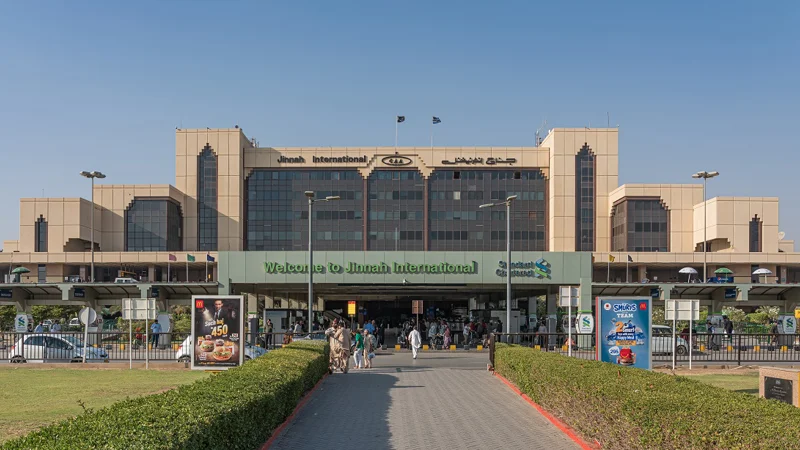
KARACHI: Pakistan's airport authority plans to expand the aging Jinnah Terminal Complex at Jinnah International Airport in Karachi and will hire an international consultant to oversee the multibillion-rupee project, according to an official document.
The Pakistan Airports Authority (PAA) said the existing terminal complex and its airside and landside infrastructure are more than 30 years old, and the authority lacks comprehensive, up-to-date assessment reports, digital as-built models and detailed condition surveys for many structural elements, utilities, mechanical and electrical systems, baggage handling, information technology, security and other installed systems.
The expansion is intended to raise the airport's overall capacity to 20 million passengers per year.
Under the plan, the consultant will provide feasibility studies, airport planning, preliminary and detailed architectural and engineering design, procurement support and field design support services.
The consultant will review existing terminal and airport infrastructure, utilities and ongoing or planned developments, and carry out feasibility, constraints and options assessments.
It will also analyze historical passenger traffic, aircraft movements, peak-hour profiles, origin-destination patterns, airline and aircraft fleet mix and baggage flows, and prepare low, base and high demand forecasts through 2050.
Site studies will include topographic and geotechnical investigations, utility assessments and an Obstacle Limitation Surfaces study. A high-level greenfield assessment limited to preliminary site selection criteria is also included, though detailed design, surveys or investigations for a greenfield airport are not part of the scope.
The consultant will assess terminal processing facilities, gates, lounges, baggage handling, commercial and support facilities, landside access, curbside areas, parking, airside facilities, aircraft stands, taxiways and ground support equipment areas. It will develop a concept and master plan and a phased development strategy.
Expansion options to be evaluated include modernization of the existing terminal, a new terminal, satellite concourses and hybrid solutions, taking into account constructability, operational efficiency, future expansion, resilience, technology adaptability, aviation security compliance and integration with existing systems.
The authority also wants preliminary capital and operating cost estimates, a revenue assessment, financial and economic analyses, funding requirements, environmental and social impact screening, a risk assessment and management plan, and a recommended option with an implementation strategy.
Preliminary architectural and engineering designs will cover structural, electrical, telecommunications, mechanical and HVAC, firefighting, baggage handling, ICT, security, special airport systems, utilities, access roads, parking, airside and landside infrastructure and landscaping, along with preliminary cost estimates.
If the feasibility study is positive and the project is authorized, the consultant will develop complete tender-ready designs, specifications, bills of quantities, cost estimates and construction documents.
It will implement coordinated building information modeling, including 4D construction phasing and passenger-flow simulation and 5D cost-loaded sequencing, with clash detection and asset information for facility management.
The plan requires green terminal measures, energy and water efficiency, renewable energy opportunities, accessibility and universal design, improved passenger experience, retail and commercial functions and digital technologies.
It also calls for ECAC Level 3/5 security requirements, baggage handling and security integration, electronic gates, advance passenger information and passenger name record systems and border-control automation, while maintaining safe and uninterrupted airport operations during phased construction.