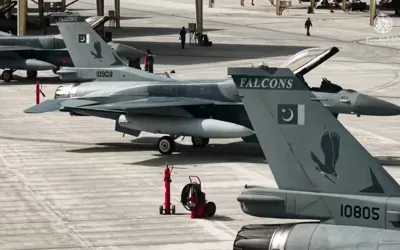
ISLAMABAD: Pakistan has taken a major step toward strengthening its air combat capabilities after successfully testing its first locally developed Fa’az air-to-air missile, the military's media wing announced on Tuesday, Nov. 3, 2026 by highlighting the country's growing expertise in defense technology.
The Inter-Services Public Relations (ISPR) said the successful flight test marked an important achievement in Pakistan's efforts to develop advanced aerospace and military systems through domestic research and engineering.
The Fa’az missile features an advanced terminal guidance system designed to help it track and engage aerial targets over longer distances.
According to the military, the technology will improve the Pakistan Air Force's (PAF) operational flexibility and strengthen its ability to respond to aerial threats.
The missile's guidance system allows it to adjust its flight path toward a target during the final stage of its journey.
This feature plays an important role in air-to-air combat, where accurately tracking and intercepting moving aircraft is essential.
However, the ISPR did not release specific technical details, including the missile's maximum range, speed or dimensions. It also did not clarify when the weapon system could enter operational service.
The announcement comes as Pakistan continues to develop its domestic aerospace and defense industry. The JF-17 Thunder, jointly developed by Pakistan and China, remains a key part of the Pakistan Air Force's modernization program. However, the military did not identify which aircraft was used to launch the Fa’az missile during the latest test.
Senior military officers, scientists and engineers involved in the missile's development witnessed the successful flight test. President Asif Ali Zardari, Prime Minister Shehbaz Sharif, Chief of Army Staff and Chief of Defence Forces Field Marshal Syed Asim Munir, and the services chiefs congratulated the scientists and engineers behind the project.
The country's leadership praised their technical skills, commitment and efforts to strengthen Pakistan's locally developed defense capabilities.
The latest achievement follows a series of missile tests announced by the ISPR in recent weeks.
On Oct. 6, Pakistan successfully tested the extended-range Fatah-4 ground-launched cruise missile. Another test involving the Fatah-2 Extended Range hypersonic ballistic missile was announced on Oct. 13.
The Fa’az flight test adds an air-to-air weapon to Pakistan's recent defense technology developments, reflecting the country's continued efforts to expand its domestic capabilities in military aviation and missile systems.