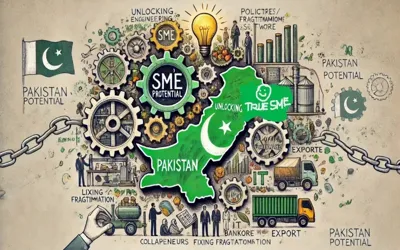
Small and medium-sized enterprises (SMEs) play a vital role in job creation, innovation, and economic development. According to the Small and Medium Enterprises Development Authority (SMEDA), SMEs contribute approximately 40% of Pakistan's GDP and generate nearly 78% of total employment. However, many Pakistani businesses struggle to expand because of limited financing, rising operating costs, skills gaps, and economic uncertainty.
According to the State Bank of Pakistan, SME financing accounted for only 6.55% of domestic private-sector financing in September 2025, despite recent lending growth.
Business sentiment reflects the same pressures: in Gallup Pakistan's Business Confidence Survey for Q1 2026 (510 businesses, conducted April 2026), only 41% of businesses described their current operations as good or very good, and the survey's direction-of-country score fell to −32%.
Unlike developed economies, where businesses often have access to diverse funding sources and stronger support networks, Pakistani SMEs frequently struggle to secure the investment needed to grow. To bridge this gap, investment platforms create opportunities for businesses to connect with investors and explore funding options that support long-term growth.
Understanding these challenges is essential to helping Pakistani SMEs overcome growth barriers and build sustainable businesses.
Key Reasons Why SMEs in Pakistan Struggle to Grow
Several interconnected factors prevent small and medium-sized enterprises (SMEs) in Pakistan from reaching their full growth potential. From limited financing and rising operating costs to policy uncertainty, skills shortages, and barriers to international trade, these challenges can make it difficult for businesses to expand sustainably.
1. Limited Access to Business Financing
One of the biggest challenges SMEs in Pakistan face is securing enough financing to expand. A business may have consistent sales and a promising customer base but still lack the funds needed to purchase machinery, increase inventory, hire employees, or open another branch.
Banks commonly assess several factors before approving a loan, including:
- Repayment capacity: Whether the business can repay the loan on time.
- Financial records: Whether the company maintains accurate accounts and cash-flow statements.
- Collateral: Whether the business can offer assets as security.
- Credit history: Whether the owner or business has a reliable borrowing and repayment record.
Smaller businesses may struggle to meet these requirements, particularly when they operate with informal accounts or have limited assets.
According to the State Bank of Pakistan's SME financing data, outstanding SME financing reached approximately Rs686.17 billion in September 2025, compared with Rs478.37 billion in September 2024. However, SME financing represented only 6.55% of domestic private-sector financing in September 2025.
Although lending has increased, these figures do not establish how much unmet demand remains or how many viable businesses still cannot secure suitable financing.
In comparison, developed economies often provide businesses with a broader range of funding options. The OECD's 2026 financing scoreboard tracks SME debt, equity, asset-based finance, and other financing conditions across 48 countries.
To help Pakistani SMEs grow, financing options should reflect different business needs:
- Small retailers may need working capital to maintain inventory.
- Manufacturers may require long-term funding for machinery and equipment.
- Technology startups may benefit from equity investment or other growth-focused funding.
- Established businesses may need expansion capital to enter new markets or open additional branches.
Improving access to suitable and affordable financing could help viable Pakistani businesses invest in growth instead of remaining focused on day-to-day survival.
2. High Financing Costs and the Cost of Capital
Access to finance is only part of the problem. The cost of obtaining it can also determine whether expansion makes commercial sense.
When borrowing costs are high, businesses may postpone equipment purchases, reduce hiring, or avoid taking on larger orders. Inflation and exchange-rate fluctuations can add pressure by increasing the cost of imported machinery, raw materials, and replacement inventory.
- The OECD's 2026 financing report notes that borrowing costs for SMEs remain elevated relative to pre-pandemic levels in many countries, even as financing conditions have eased in some markets. Its findings demonstrate that expensive credit is not unique to Pakistan, although its consequences depend on each country's financial system and economic conditions.
- For a Pakistani business, the difficulty can be particularly significant when a loan must finance long-term investment, but repayment begins before the investment generates sufficient returns.
- There is also an important distinction between debt and equity. Debt requires repayment according to agreed terms, while equity investment generally involves sharing ownership and future returns. Sharia-compliant financing structures may offer additional options, depending on the business, its cash flows, and the terms available.
A stronger financing ecosystem should provide suitable choices rather than expecting every SME to rely on conventional bank borrowing.
3. Tax Complexity and the Cost of Formalization
Formal registration can help businesses access bank financing, join larger supply chains, build credibility, and serve corporate customers. However, the perceived cost and complexity of formalization may discourage smaller businesses from registering.
Business owners must manage several responsibilities, including:
- Business registration: Completing the required registration procedures.
- Financial recordkeeping: Maintaining accurate accounts and transaction records.
- Tax compliance: Filing the appropriate tax returns and meeting legal obligations.
- Administrative requirements: Understanding tax rules and keeping up with regulatory changes.
When procedures are complicated or poorly explained, entrepreneurs may spend valuable time on paperwork instead of serving customers and improving their businesses.
Tax is now the single most-cited barrier to doing business in Pakistan. In the National Citizen Survey 2026, 46% of respondents identified the complex tax system as their primary obstacle, well ahead of access to finance (19%), corruption (12%), and energy costs (10%). The complaint combines rates, complexity, and administration: businesses are not only taxed, but they must spend significant time understanding overlapping federal and provincial requirements in order to comply.
International assessment points in the same direction. The World Bank's Business Ready (B-READY) 2025 report places Pakistan in the lower tiers overall, with a Regulatory Framework score of 62 out of 100 and a Public Services score of 55 out of 100, reflecting the compliance environment businesses operate in.
Pakistan could make formalization easier and more attractive through practical improvements such as:
- Simpler digital filing to reduce paperwork and save time.
- Clear tax guidance to help small businesses understand their obligations.
- Predictable regulations so owners can plan their operations with greater confidence.
- Better access to financing and contracts to give registered businesses tangible benefits.
Ultimately, formalization should offer more than compliance. By making registration easier and providing clear commercial benefits, Pakistan can encourage more SMEs to maintain transparent records, build trust, and pursue sustainable growth.
4. Policy Uncertainty and Economic Instability
Businesses need a reasonable degree of certainty to plan investments, hire workers, and manage costs. Frequent changes in inflation, exchange rates, taxation, import rules, and energy prices make long-term decisions difficult.
The World Bank reported that Pakistan's economy grew by 3.0% in FY2025, up from 2.6% in FY2024, but economic and climate-related risks remained.
Business sentiment data shows how quickly confidence can move. In the Gallup Confidence Survey, the direction-of-country score fell to −32% in Q1 2026, from −8% in the previous quarter, and 57% of businesses expected conditions to worsen in the coming months.
Swings of this size make owners reluctant to commit to hiring, leases, or equipment purchases that only pay back over several years.
While developed economies also face uncertainty, predictable regulations and consistent policies help businesses plan with greater confidence. Pakistan's SMEs need clear rules and timely policy communication to support long-term growth.
5. Expensive and Unreliable Energy
High electricity costs and frequent power outages create major challenges for Pakistan's SMEs, particularly manufacturers, restaurants, and service businesses. They increase operating expenses, delay production, damage inventory, and can lead to missed deadlines.
10% of respondents identified high energy costs as the primary obstacle to doing business. Energy pressure is broader than business alone: in the same survey, 19% of all respondents named rising electricity and gas prices as the single most critical challenge facing the nation.
For example, a small manufacturer may need expensive backup power to complete orders on time, reducing profits and risking customer relationships.
Pakistan can support SME growth by improving electricity reliability, making industrial tariffs more predictable, reducing avoidable energy costs, and encouraging energy-efficient machinery. Reliable and affordable energy is essential for helping small businesses control costs and compete effectively.
6. Low Productivity, Limited Technology, and Skills Gaps
Sustainable growth requires more than increasing sales. SMEs must also improve productivity, maintain quality, manage inventory, and train employees. However, outdated machinery, manual processes, and limited technical skills can make expansion difficult.
Skills shortages rarely appear as a business's single headline complaint — cost, credit, and energy pressures rank ahead of them — but they surface inside businesses as low productivity, rework, quality problems, and supervision costs, and they become more binding as a business tries to scale beyond what the owner can personally oversee.
Digital tools can help SMEs improve efficiency. For example, inventory software can reduce excess stock, while digital accounting helps businesses track costs and profit margins.
Pakistan's SMEs need affordable technology, practical training, and stronger management skills to increase productivity and grow sustainably.
7. Informal Operations and Weak Financial Records
Many SMEs start with basic bookkeeping and owner-managed operations, which may work initially but become barriers when seeking loans, investors, or larger contracts. Incomplete financial records, mixed personal and business finances, and unclear ownership make it harder to demonstrate financial credibility.
Informality is not always a sign of poor management. High compliance costs and limited guidance can discourage formalization, but weak documentation may restrict access to growth capital.
The Pakistan Bureau of Statistics provides data on informal employment, although it is not a direct measure of unregistered SMEs.
To prepare for growth, businesses should maintain separate accounts, record transactions consistently, document ownership, and prepare regular financial statements. Strong financial records and governance help SMEs build credibility and expand beyond the founder’s direct supervision.
8. Limited Access to International Markets and Export Opportunities
Exporting helps SMEs reach new customers, diversify revenue, and reduce dependence on local demand. However, entering international markets requires competitive pricing, consistent quality, suitable packaging, reliable shipping, and knowledge of foreign regulations.
Current international assessment confirms that cross-border trade remains a weak point. The World Bank's Business Ready (B-READY) 2025 report scores International Trade among Pakistan's lowest-performing business-environment topics, alongside Dispute Resolution and Market Competition, even as Business Entry scores comparatively well (86.64 out of 100, ranked 17th among 101 economies).
Pakistan's SMEs could benefit from practical export guidance, certification support, market research, and connections with overseas buyers. Digital marketplaces also offer opportunities, but success depends on reliable delivery, product quality, and understanding international customer needs.
9. Limited Long-Term Capital and Investor Networks
Bank loans can help SMEs cover inventory and operating costs, but larger expansion plans may require equity investment, strategic partnerships, asset-based financing, or Sharia-compliant funding. Each option has different costs, risks, and requirements.
The OECD’s 2026 financing scoreboard highlights the importance of diverse funding options. Meanwhile, theState Bank of Pakistan’s September 2025 review reported approximately Rs106.96 billion in outstanding Islamic SME financing.
Businesses exploring SME financing and investment opportunities in Pakistan can consider platforms such as Amanah Ventures, which connects business owners and investors through opportunities including equity investment and Sharia-compliant financing.
Choosing suitable funding, conducting due diligence, and agreeing on transparent terms can help SMEs pursue expansion while managing financial risks.
10. Limited Access to Capital for Business Expansion
Access to capital is essential for small and medium-sized enterprises (SMEs) looking to expand their operations, invest in new products, and reach more customers.
However, many Pakistani businesses struggle to secure the funding needed to turn growth plans into reality. Limited financing can prevent companies from opening new outlets, increasing production, or investing in marketing and technology.
Building a successful business often requires a combination of reinvested profits, strategic financial planning, and access to suitable funding opportunities. Businesses that manage their resources effectively can gradually expand their operations and strengthen their market position.
For Pakistani SMEs, improving access to capital and making strategic investments can create opportunities for sustainable growth. Whether funding is used to expand retail operations, improve production capacity, or strengthen digital sales, the right financial resources can help businesses compete more effectively and reach new markets.
What Can Pakistan Do to Help SMEs Grow?
Addressing these challenges requires coordinated action rather than a single policy or financing program.
- Government: Simplify business registration and tax compliance, improve policy predictability, and strengthen infrastructure and export facilitation.
- Banks and financial institutions: Develop financing products suited to different business sizes, cash-flow patterns and investment needs. Improve access to transparent credit assessments and appropriate Sharia-compliant options.
- Investors and capital providers: Evaluate viable businesses on their commercial potential, financial records, management quality and realistic growth plans. Provide suitable funding structures instead of assuming all businesses need the same product.
- Business owners: Improve bookkeeping, separate personal and business finances, invest in staff training, adopt relevant digital tools, and build realistic expansion plans.
- Industry associations and training institutions: Connect SMEs with technical expertise, mentoring, export guidance, suppliers and potential business partners.
Pakistan also needs better, regularly updated SME data. Clear information about business size, productivity, credit access, survival rates, and export participation would help policymakers target interventions and measure whether they are working.
The goal should be to remove unnecessary barriers while encouraging financially responsible businesses to become more productive, formal, and competitive.
Conclusion: Pakistan Needs to Help SMEs Move Beyond Survival
In a nutshell, Pakistan's SMEs can drive employment, exports, and economic growth, but financing challenges, policy uncertainty, energy costs, and limited access to technology continue to hold many businesses back.
Addressing these barriers requires affordable financing, reliable infrastructure, clear regulations, and stronger management practices. By adapting successful international approaches to local conditions, Pakistan can help viable SMEs expand, create jobs, and build sustainable businesses.
Author: Muhammad Nabeel is a financial advisor in Pakistan and has invested in several businesses in Pakistan.