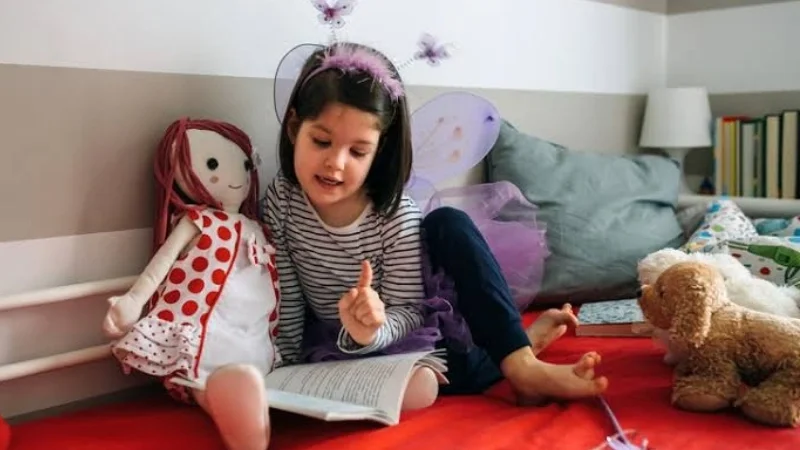
Imaginary friends are a common part of childhood, with some children creating invisible companions while others give personalities to toys, stuffed animals or other objects.
Researchers say the practice can be part of normal development and does not, by itself, indicate that a child is lonely or distressed.
Imaginary companions often emerge during the preschool years, when children are rapidly developing language, social understanding and pretend-play skills. A University of Washington study found that about 65% of children had an imaginary companion by age 7, while 27% reported having one their parents did not know about.
What is an imaginary friend?
An imaginary friend is a character a child treats as a meaningful companion. It may be invisible or represented by a toy or object and can take the form of a child, adult, animal, monster, robot or other fictional character.
The important part is the relationship the child creates through imagination.
A way to practice relationships
Pretend friendships can give children an opportunity to rehearse everyday social situations. Through conversations and games, they can practice sharing, fairness, disagreements, caring for others and resolving conflicts.
This kind of play may also support theory of mind, the ability to understand that other people have thoughts, feelings and perspectives different from one's own.
When children hold conversations with an imaginary companion, they also practice language by switching between different voices, ideas and responses.
Helping children process emotions
Imaginary companions can become a way for children to explore difficult emotions, including fear, anger, jealousy, embarrassment and sadness.
Because the situations take place through play, children can examine those feelings from a safe distance. An imaginary companion can also provide a sense of companionship when a child wants someone to talk or play with.
The child is also in control of the imaginary world, allowing them to create stories, establish rules and decide how situations unfold.
Why children sometimes blame them?
Parents may occasionally hear a child blame an imaginary friend for a broken object or other mischief. While the behavior can be frustrating, it may reflect a child's developing understanding of rules, responsibility and consequences.
Parents can acknowledge the imaginary friend's role in the story while making clear that family rules still apply and that the child remains responsible for their actions.
Imaginary companions are not restricted to girls, only children or children without siblings. Some early research suggested girls were more likely to have them during the preschool years, but findings among school-age children showed boys could be just as likely to develop imaginary companions.
Children may also change or replace their imaginary friends as their interests, experiences and emotional needs develop.
The practice does not always end in early childhood. Some adolescents continue creating imaginary characters, and research has examined links between imaginary companions, creativity and coping.
During adolescence, these characters can also become a way to explore identity, fears, values and relationships.
Studies of adults who had imaginary companions as children have found associations with creativity-related traits and other personality differences. However, these findings do not establish that having an imaginary friend determines later personality or abilities.
Imaginary friends and autistic children
Autistic children can also develop imaginary companions. Research has documented imaginary play among autistic children and examined its relationship with social understanding and theory of mind.
The findings suggest that imaginary companionship can occur across different developmental and communication profiles.
How parents can respond
Parents generally do not need to discourage imaginary friendships. A calm and curious response can help children feel comfortable talking about their characters and may give parents insight into their child's thoughts and emotions.
Adults do not have to pretend the imaginary friend is real, but they can respect the child's play without mocking or dismissing it.
Parents should pay closer attention if a child appears frightened by the companion, says it is telling them to do something unsafe, or experiences major changes in sleep, eating, mood or behavior. In such cases, discussing the broader changes with a pediatrician may be appropriate.
For most children, however, an imaginary friend is simply another way to play, communicate and make sense of the world around them.