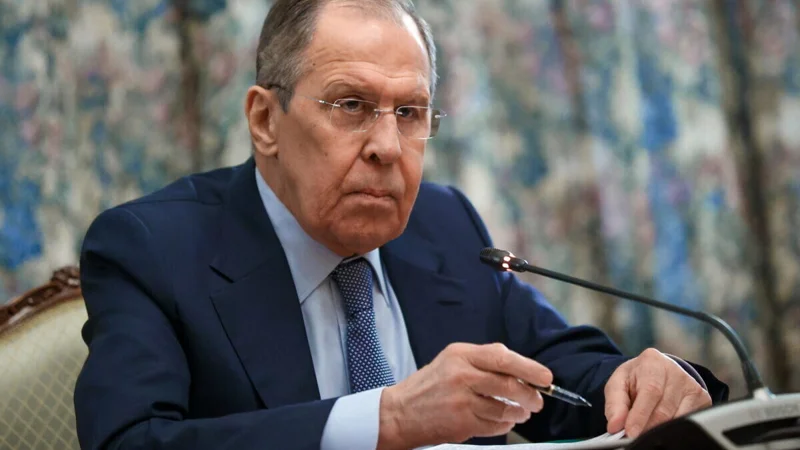
MOSCOW: Russian Foreign Minister Sergey Lavrov said Monday that incorporating Iran into a regional security framework for the Gulf would be a critical move toward stabilizing the region, as he pointed to a recent defense pact among Pakistan, Saudi Arabia and Turkiye as a potential foundation for broader cooperation.
Speaking to students and faculty at the Moscow State Institute of International Relations, Lavrov said the trilateral Makkah Joint Defence Pact, signed Aug. 7, could serve as a model for an expanded security architecture.
The agreement establishes collective defense and security cooperation among the three nations, with its newly formed Strategic Political and Defence Committee holding its first meeting in Istanbul on Aug. 31.
The pact was signed against a backdrop of escalating tensions following a joint U.S.-Israeli military campaign against Iran that began Feb. 28, which included strikes on Iranian territory and targeted senior leadership. Pakistan and Saudi Arabia had previously signed a mutual defense agreement stipulating that aggression against either would be treated as an attack on both.
Lavrov recalled that Russia had proposed more than two decades ago that Gulf countries, including Arab states and Iran, convene to develop a regional security concept.
“Recognising that relations between them are complex, we proceeded from the assumption that we would facilitate meetings, discussions of mutual grievances, and agreement on certain confidence-building measures,” he said.
He added that such discussions would be easier to organize with the simultaneous involvement of the Arab League, the Organization of Islamic Cooperation and the five permanent members of the U.N. Security Council.
Lavrov said the regional dynamic shifted after the U.S.-Israeli operation in February. He also noted the normalization of relations between Iran and Saudi Arabia, which followed a Chinese initiative that Moscow actively encouraged.
Turning to the potential expansion of the Makkah pact, Lavrov said proponents had indicated the framework could remain open to countries beyond the Gulf.
“Egypt is often mentioned. I am sure that if Algeria shows interest, that too would have a positive effect at some stage,” he said.
Lavrov described agreeing on terms for Iran’s participation as a “most practical step” toward the security model Moscow originally proposed. He added that Russia would not seek a leading role in any such arrangement.
Regional powers have been seeking stronger security ties amid the U.S.-Israeli war on Iran, which has disrupted stability and maritime traffic through the Strait of Hormuz. Turkiye possesses NATO’s second-largest military, Saudi Arabia is a major Gulf power and oil exporter, and Pakistan is the only nuclear-armed Muslim-majority nation.
On Aug. 9, Deputy Prime Minister and Foreign Minister Sen. Ishaq Dar said the Makkah pact remained open to countries committed to its core principles, emphasizing its defensive nature. Dar said the agreement was not directed against any nation and aimed to promote regional peace, stability and prosperity through mutual respect, cooperation and peaceful means.