Tuesday, November 3, 2026
Watch Live
UPDATED
FUEL PRICE
03-NOV-2026
PETROL
▼ -3.40 PKR
Rs. 374.51/ltr
DIESEL
▼ -7.76 PKR
Rs. 395.20/ltr
Headlines
US midterms put Trump’s political standing to the test Federal govt announces reduction in petroleum prices Cyberattack affects dozens of supermarkets across Europe Simple egg white face mask for your skincare routine 'Meer-e-Karwan Tum Ho' conference highlights climate challenges Major tech companies resist Trump's latest tariff push against Vietnam Netflix crime thriller 'Collision Course' tops global charts after release Field Marshal Asim Munir, Liu Haixing discuss bilateral ties at GHQ Sindh bans CNG, LPG cylinders in school vans Bird flu outbreak spreads across US poultry farms, infects 1.32m birds Pakistan fined 5% of match fees for slow over-rate in tri-nation final Pakistan to deregulate LPG pricing, add targeted subsidies Pakistan explores tokenizing Eurobond debt, Finance Minister says Karachi to get first mechanical garbage transfer system Pakistan bound LNG carrier attacked near Strait of Hormuz despite Iranian clearance US consortium proposes $4.4 billion LNG project in Pakistan US midterms put Trump’s political standing to the test Federal govt announces reduction in petroleum prices Cyberattack affects dozens of supermarkets across Europe Simple egg white face mask for your skincare routine 'Meer-e-Karwan Tum Ho' conference highlights climate challenges Major tech companies resist Trump's latest tariff push against Vietnam Netflix crime thriller 'Collision Course' tops global charts after release Field Marshal Asim Munir, Liu Haixing discuss bilateral ties at GHQ Sindh bans CNG, LPG cylinders in school vans Bird flu outbreak spreads across US poultry farms, infects 1.32m birds Pakistan fined 5% of match fees for slow over-rate in tri-nation final Pakistan to deregulate LPG pricing, add targeted subsidies Pakistan explores tokenizing Eurobond debt, Finance Minister says Karachi to get first mechanical garbage transfer system Pakistan bound LNG carrier attacked near Strait of Hormuz despite Iranian clearance US consortium proposes $4.4 billion LNG project in Pakistan

ISS study reveals viruses behave differently in space

Findings could help develop more effective treatments for antibiotic-resistant infections

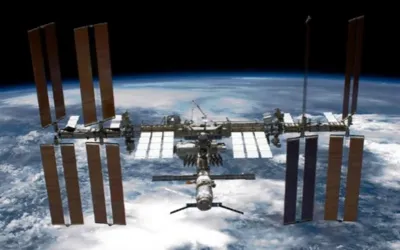
A study conducted aboard the International Space Station (ISS) has found that bacteria-infecting viruses behave differently in microgravity, a discovery that could help scientists develop new ways to combat drug-resistant infections.

Research published in PLOS Biology shows that bacteriophages viruses that target bacteria are still able to infect E. coli in near-weightless conditions.

However, both the infection process and the viruses’ evolutionary behavior differ significantly from what is observed on Earth.

The study, led by Phil Huss of the University of Wisconsin Madison, compared E. coli cultures infected with the T7 bacteriophage on Earth and aboard the ISS.

While infection in space was initially slower, the virus ultimately replicated successfully. Genetic analysis revealed that both the bacteria and the viruses developed unique mutations in the space environment.

Researchers discovered that viruses grown on the space station underwent changes in the protein they use to attach to bacteria, improving their ability to bind to bacterial cells.

At the same time, E. coli grown in space developed mutations that increased their resistance to viral attacks and enhanced their survival in microgravity.

Advanced genetic sequencing identified the specific mutations responsible for these changes. Follow-up experiments on Earth confirmed that these space-altered viruses were more effective against E. coli strains linked to human urinary tract infections, including strains typically resistant to the T7 virus.

The findings demonstrate that space-based research offers critical insights beyond understanding microbial adaptation.

Scientists concluded that microgravity reshapes virus–bacteria interactions, driving evolutionary changes that could be harnessed to engineer more powerful treatments against antibiotic-resistant bacteria on Earth.
Recommended