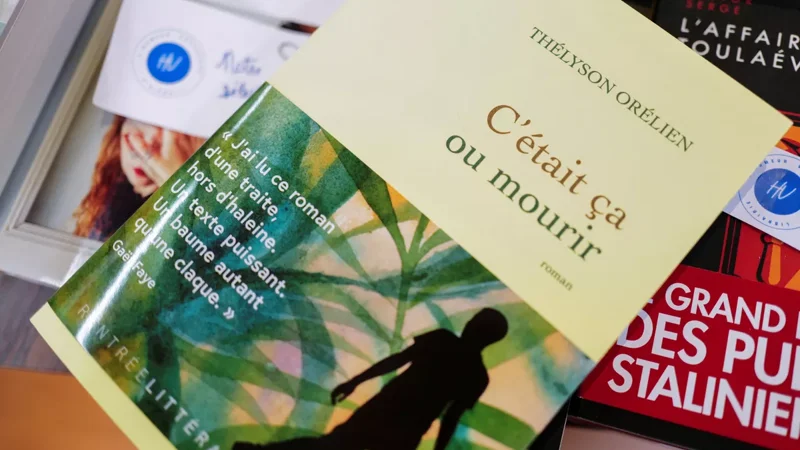
PARIS: A plagiarism and artificial intelligence scandal has shaken the French literary world, costing Haitian-Canadian author Thélyson Orélien a spot on the shortlist for France's most prestigious literary prize.
The Prix Goncourt removed Orélien's novel "It Was Either That or Die" ("C'était ça ou mourir") from its shortlist last Friday, shortly after an anonymous account on X claimed the book was written almost entirely by AI. The novel, about a Haitian's perilous journey to Canada through Brazil, Mexico and the United States, has topped French bestseller lists with about 35,000 copies sold. It won the Fnac novel prize last Monday and received rave reviews.
Orélien, 38, emigrated to Canada in 2010 after a devastating earthquake in Haiti destroyed his home. He denies using AI to write the novel.
His French publisher said Orélien began writing the book in 2017 and completed a draft in 2019, long before generative AI was commercially available. In a statement last week, Orélien, who is Black, said he had been the victim of numerous racist attacks and was compiling a dossier with his publishers in France and Quebec to prove his claims.
Samuel Fitoussi, a columnist for the conservative newspaper Le Figaro who has described himself as rather right-wing, acknowledged being part of the group project behind the X account. But the author of "Woke Fiction" denied any political motivation, saying he was defending the moral pact that binds an author and his readers and raising awareness about AI-generated writing.
After the AI allegations surfaced, Quebec newspaper La Presse published allegations of plagiarism in articles and opinion pieces Orélien wrote between 2012 and 2013. Radio-Canada subsequently found that at least five of his columns and opinion pieces were partly copied from other authors' texts.
La Presse also reported that Pangram, an AI detection tool, found Orélien's 2012 award-winning short story "Où va le monde" contained at least four identical sentences to Louis Pauwels' 1960 book "Le matin des magiciens." Orélien did not respond when contacted by La Presse.
The scandal has drawn attention to the reliability of AI detectors and raised questions about expectations of writers, with some French authors arguing AI is now part of daily life and that authorship is evolving.
Orélien has said the images, repetitions and rhythms in his work are living speech and are his own, rooted in Haitian and Caribbean traditions.
French AI expert Benoît Raphaël tested whether non-standard, highly oral French could cause Pangram to err. He submitted chapters from several Haitian novels and a sample of Orélien's pre-2023 poetry, short prose and critical writings to the detector. All were identified as human-created.
Raphaël said that before the scandal broke, he had written to another AI expert with suspicions that Orélien's novel was written with AI assistance, citing telltale signs such as overreliance on certain rhetorical constructions.
Studies have shown Pangram is highly accurate in detecting AI use, with a success rate above 95% and virtually no false positives, though they do occur. The tool has been used to raise allegations about other recent literary works, including Jamir Nazir's Commonwealth Writers Prize-winning short story, which was officially cleared. Nazir, a Trinidadian writer of East Indian heritage, told judges his writing process involved speech-to-text tools and intensive editing due to chronic health conditions.
On French television last week, author Virginie Despentes, whose novels include the International Booker-shortlisted "Vernon Subutex 1," rejected the idea that authors should be held accountable for AI use, saying Orélien doesn't have to justify himself and can write however he wants.
Despentes praised the novel's short sentences, powerful metaphors and episodic nature as typical of contemporary writing. Raphaël Doan, co-creator of a 2023 alternative history he openly wrote with ChatGPT, appeared alongside her and said he believed Orélien had used AI, citing the novel's formulaic style, hackneyed imagery and storyline that skips from scene to scene.
Alexandre Gefen, author of "Culture History of AI," compared Orélien to a Renaissance artist populating his studio with other artists working at his command, saying authorship has always evolved with writing technologies.