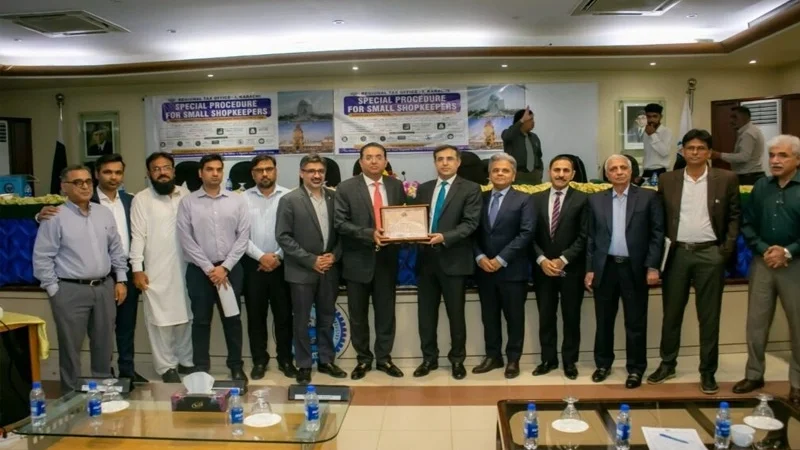
KARACHI: Member Inland Revenue (IR) Zubair Bilal has described the Aasan Tax Return Filing facility as one of the most liberal and trader-friendly tax initiatives introduced in decades, urging small traders and shopkeepers to take full advantage of the opportunity, voluntarily enter the formal tax system and conduct their businesses with greater confidence and peace of mind.
Speaking at an Awareness and Facilitation Session on Aasan Tax Return Filing organized by the Karachi Chamber of Commerce & Industry (KCCI), Zubair Bilal said that during his 31 years of service, he had witnessed various schemes aimed at bringing traders into the tax system, but the present initiative was exceptionally liberal and offered small traders a valuable opportunity to regularize their tax affairs through a much simpler mechanism.
The session was widely attended by small traders, shopkeepers and representatives of the business community. Vice Chairmen Businessmen Group (BMG) Anjum Nisar and Jawed Bilwani, President KCCI Muhammad Rehan Hanif, Senior Vice President Muhammad Raza, Vice President Muhammad Arif Lakhani, Chairman KCCI Federal Taxation Subcommittee Abu Bakar Siddique Ahmed Shamsi, along with other members of the business community, were also present.
Zubair Bilal categorically assured the traders that they should not view the initiative with fear or suspicion. Rather, it should be seen as an opportunity to become part of the documented economy through an easier system backed by a grievance-redressal and facilitation mechanism.
He stressed that the objective should not be to force small traders into compliance through intimidation but to convince them why becoming part of the tax system was beneficial for them and for the country.
Drawing an analogy, he said that just as a child cannot be encouraged to study by constantly standing over him with a stick, traders cannot be sustainably brought into the tax system merely through coercion. They have to be properly guided, facilitated and convinced about the advantages of compliance. Once traders understand the system and have confidence in it, they will voluntarily become part of it and contribute towards making it successful.
He particularly encouraged shopkeepers and market representatives attending the KCCI session to spread awareness among their fellow traders and persuade them to avail themselves of the facility. He added that traders should approach the initiative positively, as becoming part of the formal system would provide them greater certainty and enable them to conduct their businesses with confidence.
Member IR further assured that a proper grievance-redressal mechanism was available for addressing genuine difficulties faced by traders. He emphasized that the tax authorities would remain accessible and that complaints and difficulties brought to their attention would be addressed. He also assured the business community of continued cooperation and facilitation, stating that officials would remain available to deal with complaints and concerns.
Highlighting Karachi’s extraordinary importance to the national exchequer, Zubair Bilal paid glowing tribute to the city and its business community for their enormous contribution to Pakistan’s revenue generation. He observed that Karachi occupies an exceptional position in the country’s taxation landscape and acknowledged that a very substantial share of tax collection comes from the metropolis.
He pointed out that even a single Large Taxpayers Office accounts for roughly one-third of the country’s tax collection, while Karachi’s contribution becomes even more significant when collections through its other tax offices are taken into account. He said this demonstrated the immense contribution being made by Karachi’s businesses and taxpayers towards sustaining the national economy.
Zubair Bilal also expressed his admiration for Karachi and its people, describing the metropolis as a uniquely diverse, multicultural and industrious city whose people possess a strong work ethic and welcoming character. He said his experience in Karachi had given him enormous respect for the city and its business community, and he frequently spoke highly of Karachi even after leaving the city.
Referring to the philosophy behind voluntary tax compliance, Member IR said taxpayers must appreciate that the revenue they contribute ultimately belongs to Pakistan and is utilized for the country’s benefit. “Our common identity and reference are Pakistan,” he observed, emphasizing that every contribution made by taxpayers ultimately serves the nation.
He stressed that the success of the Aasan Tax Return initiative would ultimately depend on building trust between the tax administration and the trading community. Instead of creating apprehension among small shopkeepers, the emphasis must remain on education, facilitation, accessibility and confidence-building so that traders willingly become compliant.
Zubair Bilal further explained that the system incorporates verification features, including QR Code-based verification, enabling taxpayers to check the authenticity of relevant documentation through their mobile phones. Such measures, he indicated, were aimed at improving transparency and giving taxpayers greater confidence while interacting with the system.
He urged the traders present at KCCI to act as ambassadors of the initiative in their respective markets and encourage fellow shopkeepers to understand and use the simplified mechanism rather than remaining outside the tax system because of apprehensions or misconceptions.
Member IR reiterated that the authorities stood ready to cooperate with the trading community and address genuine complaints. He assured participants that whenever traders encountered a legitimate difficulty, the relevant authorities would remain accessible for its resolution and would extend necessary cooperation.
The awareness and facilitation session at KCCI provided small traders and shopkeepers an opportunity to directly interact with senior tax officials, understand the simplified return-filing mechanism and raise their concerns regarding compliance. The large participation of traders reflected the business community’s keen interest in understanding the new facility and obtaining clarity on its practical implementation.